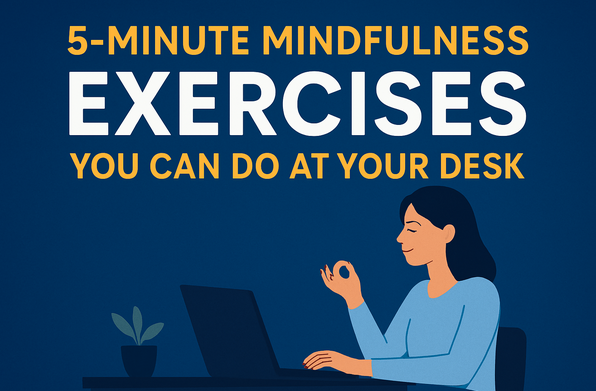

Best 5-Minute Mindfulness Exercises for Office Workers
In today’s fast-paced work culture across the United States, stress, mental fatigue, and burnout are becoming more common than ever. Whether you work in a corporate office, a hospital, a call center, or from home, your mind is constantly juggling deadlines, meetings, and never-ending notifications. This is exactly where 5-minute mindfulness exercises can make a powerful difference.
Mindfulness isn’t just a wellness trend—it’s a science-backed method for reducing stress, improving focus, enhancing productivity, and supporting long-term mental health. The best part? You don’t need yoga mats, candles, or a quiet room. You can practice effective mindfulness at your desk in less than five minutes.
These desk-friendly exercises fit perfectly into the busy lifestyle of American working professionals looking for quick stress relief, better concentration, and mental clarity during long work hours.
Why Mindfulness Matters for American Workers
According to the American Psychological Association, more than 70% of U.S. workers experience stress that affects their mental and physical health. Long sitting hours, digital overload, and demanding schedules make it difficult to stay calm and focused.
Mindfulness helps by:
- Reducing cortisol levels (stress hormone)
- Improving emotional regulation
- Enhancing workplace productivity
- Preventing burnout
- Supporting mental resilience
For more science-backed details, you can explore:
- APA: Stress in America Report
https://www.apa.org/news/press/releases/stress - NIH: Mindfulness and Health
https://www.nccih.nih.gov/health/mindfulness
Read More : The 90 Minute Rule: A Healthier Way to Work Smarter
5-Minute Mindfulness Exercises for Office Workers that You Can Do at Your Desk
These exercises are simple, effective, and require no tools—perfect for busy U.S. professionals.
1. The 5-Breath Reset (Deep Breathing Technique)
This exercise quickly resets your nervous system and helps reduce anxiety within seconds.
How to do it:
- Sit upright in your chair with both feet flat.
- Close your eyes or soften your gaze.
- Take a slow deep breath in for 4 seconds.
- Hold for 2 seconds.
- Exhale slowly for 6 seconds.
Repeat five times.
Why it works:
Deep breathing signals the brain to switch from “stress mode” (fight or flight) to “relax mode” (parasympathetic system). It’s also recommended by the Cleveland Clinic for reducing work stress.
More on breathing techniques:
https://my.clevelandclinic.org/health/articles/9445-deep-breathing
2. The 5-Minute Body Scan
This is one of the most recommended mindfulness techniques in the U.S. mental health world because it helps workers reconnect with their body and reduce tension.
How to do it:
- Sit comfortably and close your eyes.
- Start by noticing your feet—are they tense or relaxed?
- Move up: legs, hips, back, shoulders, arms, neck, and face.
- At each area, take one breath and release any tightness.
Why it works:
It helps break the cycle of “mindless stress tension” caused by long desk hours.
Learn more from the U.S. Department of Veterans Affairs (VA):
https://www.mindfulness.va.gov/mindfulness/body-scan.asp
Also Read : Early Signs of Burnout at Work – Recognize & Prevent Employee Burnout in the USA
3. The Desk-Grounding 5-4-3-2-1 Technique
This is a high-traffic keyword topic: “grounding exercises for anxiety.”
How to do it:
Look around your workspace and identify:
- 5 things you can see
- 4 things you can touch
- 3 things you can hear
- 2 things you can smell
- 1 thing you can taste or imagine tasting
Why it works:
This technique is widely used in U.S. therapy practices to help workers dealing with anxiety attacks, overwhelm, or sensory overload.
More grounding techniques at:
https://www.therapy aid.org/grounding-exercises
4. The 2-Minute Gratitude Pause
A powerful mindfulness method backed by Harvard Health for improving happiness and job satisfaction.
How to do it:
- Pause and take one deep breath.
- Think of three things you’re grateful for at this moment.
- They can be small—like your morning coffee, your job security, or supportive coworkers.
- Breathe deeply and visualize them.
Why it works:
This resets your emotional system, reduces negative thinking, and boosts motivation.
Harvard gratitude research reference:
https://www.health.harvard.edu/healthbeat/giving-thanks-can-make-you-happier
5. The 60-Second Desk Stretch With Mindfulness
Mindfulness doesn’t need to be still—you can pair it with light stretching.
How to do it:
- Sit tall and roll your shoulders slowly while breathing deeply.
- Gently rotate your neck in slow circles.
- Stretch your arms overhead and inhale.
- Exhale while bringing your hands back down.
Why it works:
Combines physical relaxation + mindful breathing, helping with neck pain, back stiffness, and mental fog.
The CDC recommends micro-breaks and desk stretches for U.S. office workers:
https://www.cdc.gov/niosh/topics/ergonomics
Read This : 10 Daily Habits to Reduce Work Stress Naturally
6. One-Minute Mindful Email Check
Choose one email and read it slowly, observing:
- Your breath
- Your emotions
- Your posture
- Your reactions
Instead of reacting immediately, pause for one deep breath before replying.
Why it works:
Reduces impulsive responses and workplace conflict—very common in fast-paced American offices.
7. Sound Meditation (Using Your Office Environment)
Instead of resisting office noise, use it as a mindfulness tool.
How to do it:
- Close your eyes.
- Pay attention to the sounds around you—keyboards, AC, distant chatter.
- Don’t label them as good or bad.
- Just observe them for 60-90 seconds.
This is highly effective for remote workers too—especially those working in busy home environments.
8. The 5-Minute Mindful Vision Break
This protects your mental health and your eyes.
How to do it:
- Look away from your screen.
- Focus on an object at least 20 feet away.
- Slowly breathe as you observe its color, shape, and details.
Why it works:
Combats digital eye strain, which affects more than 60 million U.S. employees who work on computers.
American Academy of Ophthalmology’s eye health guide:
https://www.aao.org
The Science Behind 5-Minute Mindfulness
Studies from NIH, Yale, and Harvard Medical School show that short, frequent mindfulness breaks:
- Increase gray matter in brain regions responsible for emotional control
- Reduce stress by 40%
- Improve focus and memory
- Increase job satisfaction
It is one of the simplest, most cost-effective mental health strategies for U.S. professionals.
How to Make Mindfulness a Daily Habit at Work
Here are habits that work well for American work culture:
✓ Add a 5-minute mindfulness reminder to Google Calendar
✓ Use phone apps like Calm or Headspace
✓ Do one mindfulness exercise before lunch
✓ Use mindful breathing before joining stressful meetings
✓ Keep a small gratitude notebook at your desk
Even one exercise per day can transform your mental clarity and emotional balance.
Final Thoughts
Mindfulness doesn’t require long sessions or special tools. A simple 5-minute break at your desk can reduce stress, improve productivity, and help you stay centered throughout your workday. These exercises fit into the lifestyle of busy American workers who want quick stress relief, better focus, and stronger mental well-being without stepping away from their workspace.
Start with just one technique today—you’ll feel the difference.